
Category Archives: The Essence of Networks

Measuring Reciprocity

In Connecting we emphasize that reciprocity–giving and taking, mutual exchange, between a network’s members–is a powerful social dynamic that, combined with a network’s decentralized structure, unleashes a network’s effects and advantages. Members give away their knowledge, skills, connections, and resources. They give in the expectation that giving to others will be rewarded by getting from others. But it’s not a negotiation, it’s a “gift economy,” in the phrase of Kevin Kelley.

So how do you measure the degree to which reciprocity is happening in a network? This question was posed the other day by a network builder in a conversation with five other network builders.

From the conversation, it seemed that reciprocity can be manifested in three ways in a network:

1. Expectations that a member has of another member. Does a member feel he/she can count on a particular other member to, for instance, listen and respond to a question in a timely fashion? In other words, you could ask members about their perception of/relationship with specific other members.

2. Transactions/behaviors between members. Do members in the network actually listen and respond in a timely fashion to a question? In other words, you could observe and count members’ behaviors that reflect reciprocity.

3. The culture of the network–the norms, habits–of members as a whole. Do members feel that relationships within the network are guided by a valuing of reciprocity? In other words, you could ask members what they think network norms are.

What Makes Generative Networks Tick?

Networks of individuals and organizations that aim to solve a difficult problem in the society by working together, adapting over time, and generating a sustained flow of activities and impacts: in Connecting to Change the World we call these generative social-impact networks. “Generative” because they are designed to be a platform for generating multiple, ongoing kinds of social impact, not just accomplishing a single outcome. It’s a unique and renewable capacity that is especially useful when taking on complex, unpredictable, large-scale problems like climate change, homelessness, or education-system performance, which won’t yield to a “silver-bullet” solution.

In a generative network the members are deliberate about building, strengthening, and maintaining ties with each other. Over time they forge a renewable collaborative capacity that generates numerous activities simultaneously. Together, they innovate to create new products, services, and programs; learn which practices/policies work, then adopt and spread them; advocate for changes in public policies; coordinate provision of services; set up joint purchasing and branding; and organize to develop and use private, philanthropic, and public investment. Over the years, their networks become more robust and adaptive enough to maintain their effectiveness and steadily increase their impact.

In such networks, decision-making is distributed among the members, not concentrated at the top or with the staff. The members are volunteers; they set the agenda and priorities and do most of the work. There are minimal formal rules and the structure is non-hierarchical. This “looseness” makes networks less stable but more nimbly adaptive than organizations.

Networks do not automatically become generative and able to sustain a high level of member engagement, activity, adaptation, and impact. What’s the “secret sauce” that makes all of this possible?

Generative networks combine powerful social dynamics—the basic human desire to connect, share, belong, and make a difference—with a decentralized structure that enables members. It sets two social forces into motion: the generosity with which members treat each other and the shared sense of identity they develop.

  • Generosity. Members give to each other, giving away their knowledge, skills, connections, and resources. It’s a “gift economy.” They give in the expectation that giving to others will be rewarded by getting from others, that mutual exchange—reciprocity between members—will occur in the network.
  • Shared Identity. When this member-to-member exchange happens, the network’s decentralized structure magnifies the value of the gifts, efficiently spreading the benefits to other members, who, in turn, enhance them and spread them even further. As a result, members don’t just bond with the members with whom they have engaged; they develop a feeling for, a loyalty toward, and a willingness to support the network as a whole. The network is a gift that keeps them giving.

When these member-to-member social dynamics exist, the network’s decentralized structure kicks in to magnify the value of the exchanges among members, efficiently spreading the benefit to other members who, in turn, enhance and spread it even further.

What’s So Special About Networks?

What networks can do especially well–better than organizations– is what makes them attractive to organizers and investors. It boils down to four “network effects” that  a network’s decentralized structure and social capital among members are remarkably good at producing:

Assemble novel and flexible combinations of human talent. Networks can aggregate talent that would be difficult or impossible to pull together in a single organization. The aggregation can come from organizations or individuals that align their capabilities and coordinate their efforts and, in the process, create a new and powerful ability. This combined talent is especially valuable when seeking innovation, because it brings together a fresh diversity of people and ideas and can be highly responsive to opportunities and other changes. This is because a network draws on small increments of people’s time for episodic use, rather than locking them into full-time, stable work. Small amounts of hundreds of people’s time.

Enable efficient access to new resources. Networks can make it possible for their members to connect efficiently with a great many people—network members and their networks—and thus gain access to information and other resources. In an effective network, each member is connected to many other people, and through them to yet more people. When a member searches for help in the network, it’s just a connection or two away. Thanks to this multiplier effect, a network can potentially provide its members with efficient access to thousands of other people and their knowledge, skills, and resources.

Grow rapidly to “critical mass.” Networks can grow rapidly because of what’s called the Law of Increasing Returns. In a nutshell, it’s naturally in network members’ interests to have more members with whom to connect and transact. A network may expand explosively when its members bring some or all of their networks into the network—an instant infusion of new members. This growth potential and the critical mass it can achieve is one reason that foundations investing in large-scale capacities for long-term policy advocacy favor a network model.

Move and test ideas and information widely and swiftly. In networks, information flows between members through the numerous links they have established, instead of having to go through a central hub or the top of an organization chain of command before being sent out to the troops. This unmediated exchange facilitates the fast dissemination of ideas and the collection of feedback across a large and potentially diverse number of members. A network’s “collective intelligence creates a ‘cloud’ of information that many people can distribute for use,” explain Beth Kanter and Alison Fine in The Networked Nonprofit (2010, page 107).

In chapter 1 of Connecting to Change the World t here’s much more about what makes networks tick and what types of impact they can have.

Is it a Network?

There are many structures for organizing collaboration among individuals and/or organization. But they are not all the same–and we’re often asked if a particular structure is or isn’t a network. So we’ve taken the time here (and in more detail in chapter 1 of Connecting to Change the World ) to identify and differentiate some of the main structures that social activists and philanthropic funders use and support.

In general, the differences fall across a spectrum related to how structured/organized the form is. Some (like professional associations) are too organized; others are not organized enough.  As we’ve said in other contexts (and explain more of in chapter 5): networks are on the “edge of chaos,” with enough organization to stay together, but enough freedom to creatively evolve; they contain autonomous agents who share common rules.  In some of the collective forms we look at, the agents aren’t autonomous (too much structure); in others, there aren’t really common rules that bind them (not enough structure).

Type of Collective Organizing Typical Distinguishing Features Difference from a Generative Network
Coalition/Alliance of Organizations A temporary alignment of organizations to achieve a specific objective such as electing a candidate or securing adoption of a new public policy. Usually disbands when the effort has been completed. Narrower in purpose/scope than a network. (Some alliances reorganize as a generative network once their campaign is over.)
Membership-Based Association or Organization Organized mainly to pool resources and provide dues-paying members with services, often for professional development or representation within public-policy arenas. Association/organization staff does most of the work. More staff-driven, less member-to-member relationship driven, than a network. Focus is on serving members rather than members collaborating with each other.
Community of Practice Organizations and individuals loosely align and coordinate around development, adoption, and spread of innovative practices and/or policies to address a particular set of problems or opportunities. Participants typically lack a firm sense of “membership identity” and do not make explicit reciprocal commitments.  Communities of practice often have many sub-networks.
Movement Large numbers of people loosely aligned around a large cause (e.g., civil rights, environmental protection), their passion ignited by a personal desire to right a wrong. Less coherent, focused, and coordinated—and much larger, sprawling—than a generative network. A movement may contain networks; networks may spawn a movement.
Social-Media Web Alignment is around a passing cause. Online; open membership; enables many “weak ties” among participants. Less coherent, focused and coordinated, with no clear membership expectations.

The “Engine” of a High-Performing Network

The main characteristics of a generative social-impact network–a social-relationship platform designed to generate multiple, ongoing kinds of change–include:

* Shared Purpose. Members share a collective purpose that is focused on creating social good.

* Complex Problem. The problem/opportunity being focused on is a complex one with no simple solutions, and the network is committed to working on it from multiple angles.

* Member Driven. Members set the mission and goals, make the rules, and do most of the work.

* Flexible. The structure is flexible and adaptable and changes as needed.

* Internal Market for Value. Value is determined by whether members engage in an activity or not–they “vote with their feet.”

But the “engine” for these networks lies in the connections among members. (See chapters 3 and 4 of Connecting to Change the World for much more about building these connections.) Members develop deep and enduring relationships and trust with each other; the focus of the network’s relationship building is member to member, not with staff or other providers. This “social capital” is the primary asset of a generative network. Engaging in collective activities helps to develop it. In turn, the social capital increases the efficiency, complexity, and depth of the activities a network can engage in.

This “virtuous cycle” of positive feedback is the engine of a high- performing network.

Don’t Follow Jacques Cousteau

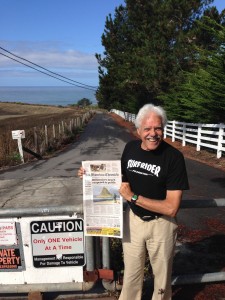
Back in The Sixties Rob “Birdlegs” Caughlan was a young surfer in California. For his college newspaper he interviewed Jacques Cousteau, world famous as  co-developer of the Aqua-Lung and a pioneer of marine conservation.” I asked him if he had any good advice for young people who wanted to help protect the ocean. He said, ‘Yes! Don’t follow gurus like me, go out and do it yourself.’”

Caughlan took the advice seriously. “I went on to write my first article on surfer power and beach access for Surfer Magazine in 1970. It encouraged surfers to get active in politics and ocean protection issues.”

"Birdlegs" today
“Birdlegs” today

Hmmm, surfers as social activists: that’s not the image most of us may have of these wave-beach-and-sun-loving folks. But we’d be wrong. Surfers care a lot about threats to the ocean and the beaches. In the 1980s, Wikipedia reports, “a handful of surfers” protested threats to their local surf break at Malibu Point. In 1984 they organized the Surfrider Foundation, and two years later Caughlan became the organization’s president.  “ We put a lot of energy into increasing membership and our political clout,” he recalled in a 2014 interview for Surfrider . “During my first years leading the organization we grew from 200 members to 25,000.”

In 1991 Surfrider organized its first local chapters of members and, Wikipedia recounts, it became a grassroots activist organization. Today, Surfrider has 50,000 members and 70 chapters worldwide.

Like many activist entities, Surfrider is a member-based nonprofit. It is driven by serving the different value propositions of its members. As Beth Kanter and Allison Fine reported in The Networked Nonprofit , Surfrider offers “a unique model of engagement” that allows members, strangers, volunteers, supporters, and leaders to participate in many different ways. “Strangers and friends can buy T-shirts online and sign up for e-mail alerts. More involved supporters and members can download and listen to podcasts and organize local beach cleanups. Leaders can arrange to meet with elected officials to discuss legislation to protect the shorelines.”

This is the beauty of networked systems, as we explain in chapter 1 of Connecting to Change the World : direct action available to everyone, amplified through collaboration among the members, and sustained by feelings of caring (about the ocean, in Surfriders’ case) and belonging, being a part of something bigger than oneself. “Birdlegs” Caughlan’s commitment to Surfriders–now in its fourth decade–stems from both feelings: “ As surfers,” he explains, “we are bonded to the ocean. It’s a personal affair. Anyone who loves the ocean, as much as we do, must do more to help solve these problems.”

I first met Rob Caughlan a couple of years ago, introduced by a friend who thought I might be interested in and helpful to Rob’s  newest passion: natural burial. Yet again, a network was at work helping its members.